Showing posts with label work out. Show all posts

Sunday, April 11, 2010

MMA Conditioning Workouts


The common misconception that many new MMA Fighters and Athletes have is that just having the ability and endurance to run 5 miles a day will somehow translate in the MMA fighter's ability to shave the proper MMA conditioning they will need to fight in the ring.

In order for the MMA Fighter to perform at a high level, during the whole fight they are going to need to train in multiple "levels" of endurance training. These types or levels of endurance relate to the muscles and their ability to perform with and without oxygen. The types of endurance training an MMA fighter most focus on is...

  • Aerobic Endurance - The ability of your muscles to perform with oxygen over long periods of time
  • Anerobic Endurance - The ability of your muscles to perform without oxygen.
  • Anaerobic Threshold - A level of exercise intensity beyond which the body cannot consume oxygen fast enough to support the energy demand. As a result, lactic acid begins to rapidly accumulate in the working muscles, hastening exhaustion.
  • Vo2Max - the maximum capacity of an individual's body to transport and utilize oxygen during physical activity.

Increasing your Fight Endurance

Increasing your endurance really means increasinh the levels and capabilities of your...

  1. Anaerobic Threshold
  2. Vo2Max
  3. Ability to relax

Increase Anaerobic Thershold

To improve your threshold you need to be perform activities at a VERY high intensity for up to 2 minutes. When performing these activities, your body learns to cope with increase lactate levels. Common exerises for increasing your Anaerobic Thershold would be any type of high intensity sprinting (running or swimming), high intensity circuit weight training, bodyweight conditioning exercises, high intenstity grappling and sparring.

When training to improve your Vo2Max - longer periods of exercise at a lower intensity. Swimming is an excellent way to increase your Vo2Max.

Relaxtion plays a huge role in the ability for a MMA fighter to perform in the cage. The ability to relax comes from experience and mental preparation. Some key tips for increasing your ability to relax during fight time are...

  1. Hard sparring and fight training: If the training is brutal and hard, the fight is a welcome release. Challenge yourself outside the cage so that the MMA fight is easy.
  2. Fight visualization - imagine everything about the fight, from getting your hands wrapped, walking out, hearing your music, entering the cage, touching gloves, the initial exchange, the techniques you before, and you WINNING the fight.
  3. Start small - enter grappling or boxing fights first, this will prepare you for the big show.

Sample Workout Circuits

The best way to condition yourself for a fight is to condition yourself according to the rounds and time of the fight. If you fight is 4 minute rounds with one minute rest, perform your exercises non-stop for 4 minutes, take 1 minute rest and repeat or go on the next stations.

When training for conditioning, it is best to setup stations.

  • Station 1: Burpees 30 seconds
  • Station 2: Jump Rope 30 seconds
  • Station 3: Sprawl 30 Seconds
  • Station 4: Instense Jab Cross Combos 30 seconds

Rest

  • Station 5: Sprawl to Double Takedown Exercise 30 Seconds
  • Station 6: Ground and Pound bag 30 Seconds
  • Station 7: Pushups 30 Seconds
  • Station 8: Jumping Squats 30 Seconds

Rest - Repeat 2 more times

You can see that you can mix in or up anything into these workouts. You can just do kicks on the bag one time, you can do all combinations on the bag, you could incorporate dumbbells, a sandbag, a parnter, etc. Get creative. As long as you keep moving at a high intensity pace, you will do well.

The Pit Workout

The Pit Workout is a dynamic, three-day per week MMA and fighter workout program designed to build speed, power and endurance. Each one-hour program includes full body conditioning while targeting specific muscle groups. Be ready to work hard, sweat and have fun while building endurance, flexibility, strength, speed and power.

The Pit, John Hackleman and MMA Roots joined together in early 2004 in order to bring you one of the most talked about and physically demanding workouts of MMA today. Combine traditional martial arts with proven modern day MMA training techniques and your result is The Pit Workout. Take your MMA workout one step further by learning the top 27 fighting techniques in modern day mixed martial arts. These techniques are the most commonly utilized tested and proven pit skills. The Pit of today is the most well rounded Martial Arts & Fitness program anywhere.

The Pit seamless fused together traditional martial arts and MMA, to create an effective disciplined workout. The Pit Workout introduces “state of the art” training and incorporates a style of fitness that is tested and proven in modern MMA today. John “The Train” Hackleman has created the fitness and fighting system that is unequaled in the Martial Arts of the 21st Century. He also shares with us over 30 years of Pit History by boiling down and reducing old school systems into a simple philosophy, “use what works and discard what doesn’t.” Whether you are training for a martial arts competition or cross training for any other sport in the world, The Pit Workout will get you closer to your goals of ultimate fitness and conditioning. Simply combine a few of the basic Pit Techniques with one of the conditioning workouts and you will also be learning how to fight in competition or defend
yourself in the streets. Always, “Train for the Worst, and Hope for the Best”

Pit Workout One:
Emphasizes the upper body with specialized push-ups and punch combinations.

Pit Workout Two:

Works the lower body through squats, lunges and kick combinations.

Pit Workout Three:

Combines both workouts in an intense full-body routine.

MMA Gym Strength Workouts


A MMA fighters gym workout needs to be different then the typical bodybuilders workout. A MMA fighter's body needs to work as a whole and requires different types of strength from different groupings of muscle.

First, an MMA fighter needs to be able to explode and needs POWER. So a good portion of the exercises that the MMA fighter must perform needs to focus on raw explosive powerful strength. The best exercises for this are Push Presses, Deadlifts, Squats, Chest Presses, High Pulls, Cleans, Snatches and the variations of these exercises.

Second, a fighter needs to have strength endurance. They need their muscles to be able to keep humming and working for them. A lot of these exercises can done in circuits in conjunction with grappling and MMA drills. You would incorporate more bodyweight exercises along with punching drills, sandbag exercises, high reps cleans and snatches, sprints, etc. The bodyweight training article has some good examples of some circuits you can do.

Lastly a fighter needs to know when to train and how often to train along with your regular MMA training. Typically most fighters train 5-6 days a week. Unless you are a pro-fighter and fighting all the time, most fighters still need to go to a job everyday so it becomes tough to fit in your grappling, boxing, and MMA training along with your strength training.

The best way to split your training and incorporate both aspects of MMA training, is work on your strength in the morning or mid-day, then do your MMA skills training at night. I would suggest strength training 2-3x a week, preferably 3. If you have a fight coming up, cut it back to 2. Many MMA schools also have a conditioning day 1-3x a week. Don't lift on those days. Lift on opposite days.

Sample MMA Gym Workout Routines:

MMA Athletes Routine for Strength and Power

MONDAY
Power Clean - 3 sets of 3 reps warm up, then 3 t5 sets of 3 reps with a work weight, about 80% of a 1RM.
Bench Press - (medium to heavy day)- (if med)- 3 sets of 5 t6 reps warm up then 3 sets of 5 with a work weight. (if heavy)- work up over six sets of 5 t6 reps to limit set of 3 t5 reps on the last set. A rule of thumb puts a limit triple at about 90% of one's 1RM.
Squat - (light speed day)- one warm up set of 10 reps. Then 5 sets of 5 reps with no more than 65% and no more than 60 seconds rest between sets. Start with 60% . Apply 100% effort on every rep and do each rep as fast as possible.

WEDNESDAY
One Power Clean followed by 3 Military Presses followed by 2 Push Presses for 5 reps total per set - 3 warm up sets, then 3 sets of 5 reps with a work weight.
Deadlift - warm up- 10 reps, 6 reps, 4 reps, then the same work weight for 3 t4 sets of 3 t4 reps. The Romanian DL or Straight Back Clean Style DL's are recommended. (On clean DL's use about 80% of your 1RM your first workout.)(On RDL's weight is not as important as doing the exercise correctly with strict form.)
NOTE: Because squats and deadlifts overlap the working of a lot of the same muscles, squats are not recommended the same day as deadlifts.

FRIDAY
Bent Row - 3 sets of 5 t6 reps warm up, then 3 sets of 5 t6 reps with a work weight.
Squat - (medium to heavy day) same formula as BP on Monday.
Bench Press - (light speed day) same formula as Squat on Monday.

Randy Couture MMA and Grappling Workout Circuit

Bent rows x8
Upright rows x8
Military press x8
Good morning x8
Lunges x8 (each leg)
Squat push press x8
Deadlift x8

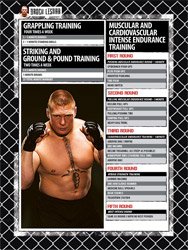
Brock Lesnar Strength Workout

Sample Strength Training: 1 Hour Workout Duration

Leading up to a fight, these exercises need to be conducted with less weight, higher intensity that will also work on overall conditioning.

Day 1: Chest & Triceps

  • Bench Press: 6 Sets 12 Reps
  • Incline Dumbbell Press: 4 Sets 10 Reps
  • Dumbbell Flyes: 3 Sets 8 Reps
  • Cable Crossovers: 3 Sets 8 Reps
  • Triceps Dips: 4 Sets 10 Reps
  • Triceps Pushdowns: 4 Sets 10 Reps
  • Skull Crushers: 3 Sets 10 Reps

Day 2: Back & Biceps

  • Wide-Grip Pull-Up: 4 Sets 6 Reps
  • Medium-Grip Pull-Up: 4 Sets 6 Reps
  • Narrow-Grip Pull-Up: 4 Sets 6 Reps
  • Seated Cable Row: 4 Sets 6 Reps
  • Stiff-Legged Deadlift: 4 Sets 6 Reps
  • Deadlift: 4 Sets 6 Reps
  • Preacher Curl: 4 Sets 12 Reps
  • Hammer Curl: 3 Sets 10 Reps
  • Incline Dumbbell Curl 3 Sets 10 Reps

Day 3: Shoulders

  • Overhead Barbell Press: 4 Sets 10 Reps
  • Seated Dumbbell Press: 3 Sets 10 Reps
  • Dumbbell Front Raise: 3 Sets 10 Reps
  • Dumbbell Lateral Raise: 3 Sets 10 Reps
  • Smith Machine Upright Row: 4 Sets 6 Reps
  • Barbell/Dumbbell Shrug: 4 Sets 6 Reps

Day 4: Legs

  • Leg Extension: 3 Sets 10 Reps
  • Leg Curl: 3 Sets 10 Reps
  • Narrow-Stance Smith Machine Squat: 4 Sets 6 Reps
  • Medium-Stance Smith Machine Squat: 4 Sets 6 Reps
  • Wide-Stance Smith Machine Squat: 4 Sets 6 Reps
  • Leg Press: 4 Sets 6 Reps
  • Stiff-Legged Deadlift: 4 Sets 6 Reps

Brock Lesnar MMA Muscular & Cardio Intense Endurance TrainingBrock Lesnar MMA Muscular & Cardio Intense Endurance Training

1st Round: Pushing Muscular Endurance - 1 Minute

  • Spiderman Push-ups
  • PlyPush-ups
  • Mounted Punching
  • Tire Push
  • Hand Switch

2nd Round: Pulling Muscular Endurance - 1 Minute

  • Recline Pull-ups
  • Bodyweight Pull-ups
  • Pulling/Pushing tire
  • Jumping Pull-ups
  • Heavy bag Twirl

3rd Round: Cardio Endurance Training - 1 Minute

  • Airdyne Bike (70rpm)
  • UBE Machine
  • Incline Treadmill (as steep as possible)
  • Windsprint Bike (standing full time)
  • Airdyne Bike

4th Round: Hybrid Strength Training

  • Jammer Machine
  • One arm Sledge Hammer
  • Medicine Ball Sprawls
  • Bear Crawls
  • Transition Station

5th Round: Most Intense Round - No Rest Periods

  • Airdyne Bike (70rpm)
  • UBE Machine
  • Incline Treadmill (as steep as possible)
  • Windsprint Bike (standing full time)
  • Airdyne Bike

Monday, February 01, 2010

She's Working Out but Gaining Weight

Putting on a few pounds after taking up exercise happens a lot. There are several possible reasons, and none of them are reason to panic. (Does this happen to you?)

by Martica Heaner, M.A., M.Ed., for MSN Health & Fitness

Q. I have been working out faithfully for three weeks now using an elliptical trainer. At first I struggled to keep going for half a mile. But now I can do 4 miles in 40 minutes. I'm clearly getting fitter, but I'm getting fatter, too! I've gained five pounds! I thought that cardio exercise was supposed to help me lose weight. I am totally discouraged.

A. Relax, you're on the road to weight loss. But it takes time to arrive at your destination. How you navigate makes a big difference in the results that you'll see.

First, congratulations on working up to exercising for a full 40 minutes! What a great accomplishment—especially considering that you were struggling to keep it up for a half mile at first. You are clearly fitter, and you're improving your health with every step.

Before you get impatient about the lack of weight loss, understand why it takes time.

When you exercise, you burn more calories than you normally would during the day. This is especially true for cardio workouts (such as walking, running, cycling, skating, dancing or exercising on the elliptical trainer), during which you burn many more calories per minute than you do during non-cardio workouts (such as yoga, light weight lifting or core-conditioning moves.) That's an important reason why cardio workouts are key for weight control—you can burn more calories faster. So you are on the right track with your elliptical-trainer sessions.

Since losing weight comes from accumulating a sizable calorie burn over days and weeks, the more calories you can burn from exercise each day, the greater the weight loss. In general, if you burn about 500 extra calories per day (and keep your diet unchanged), you'll lose around one pound per week.

But there are a few caveats.

First, it's not easy to burn 500 calories in one exercise session. If you're not in great shape to start, it may take a while before you can burn a big chunk of calories by either pushing hard enough in a shorter amount of time, or lasting long enough to work at an easier intensity for a longer time. Depending upon how much you weigh, it make take about 90 minutes of walking or one hour of running to burn about 500 calories. If you're unfit, a 30-minute workout may only produce a 250-calorie burn. That workout is still contributing to a calorie burn, but it takes a while for the total calories to add up.

Boosting the calorie burn

You mentioned that after only three weeks are you now able to keep up a moderate workout for 40 minutes. At this point, you may be burning about 300 calories during this workout (keep in mind that the calorie-burn estimate can vary). More importantly, because your sessions were shorter during the first week or two, you started off burning fewer calories per workout. If the first week you exercised for 10 minutes per session, you may have burned 100 calories or less.

You don't mention how often you've been exercising each week, but if it's three days per week, then the overall calorie burn you've accumulated is still quite small. Over the past three weeks, you may not have accumulated the 3,500 or so calories needed to lose one pound.

So that likely explains the lack of actual weight loss. In theory, you are now on track to start racking up a bigger number of total calories burned if you can work out for 40 minutes or longer each time, and especially if you can exercise on most days of the week. Most weight-loss recommendations are to exercise for five or more days a week for 60 to 90 minutes.

So why the weight gain?

So your relatively low extra-calorie burn might explain why you are not losing weight. But why are you gaining?

First, a reality check: You may not have gained a full five pounds. It's normal for body weight to fluctuate by several pounds a day depending upon fluid shifts in your body and the time at which you weigh yourself. Stepping on the scale first thing in the morning when you have not eaten in 12 or more hours will give you a slightly different number than later in the day when you may have had several meals, snacks and plenty of fluids, for example.

Still, you have noticed an upward trend on the scale. So it's possible that you have gained a few pounds.

Could the extra pounds be from new muscle?

Some people believe that people gain weight from exercise because they are building more muscle mass. In your case, this is unlikely. You can't build much muscle doing cardio. And even if you were lifting heavy weights, it would be very difficult to gain five pounds of muscle in three weeks.

Exercise and hunger

Could it be that because you are exercising more, you are eating more?

It's possible. Although there is no proof that exercising makes you hungrier (in fact, more vigorous workouts can even suppress hunger), many people eat—and overeat—for reasons other than hunger. Comfort eating can be a response to emotional, environmental or social triggers (drowning your blues with a pint of ice cream, automatically grabbing the chips while watching TV, or eating more when eating out with friends). And because food is often perceived to be a reward, a person who works out can very easily justify having an extra helping or dessert (or both) as a pat on the back for having exercised.

Controlling calories

If you exercise long enough and often enough, eating extra is necessary to replace energy stores. And chances are, even if you eat more, you still won't eat more than you burn off. But if you're only doing short workouts for only a few days per week, it will be very easy to eat more calories than you're burning and, as a result, gain weight.

Until you are at the point where you are exercising for 60 to 90 minutes per day on most days of the week, be vigilant about calorie control. You may not need to diet, but you should keep a check on whether you overeat so that you don't cancel out the calorie burn of your new exercise regimen.

When you are about to snack, pause and ask yourself whether you are really hungry. People often mistake thirst for hunger and eat when their body is really craving more fluid. You can tell if you're hydrated enough by your urine. It should always be clear, rather than yellow. If it's not, drink more water.

Eat regular meals so that you don't get overly hungry. And eat plenty of fruits and vegetables so that you eat enough fiber and bulk to feel full, but on foods that are lower in calories.

Sunday, January 31, 2010

I love working out, but I don't like to get too big....

Are you someone who doesn't just gain extra muscle when working out, but also extra bulk?

A lot of long distance runners complain of the same thing. If you are looking for lean muscle mass, then you need to find an exercise that will burn calories while you rest.

One thing you can do is interval training. You can do this while you run, do the elliptical, jump rope or bicycle. It burns those calories up to 5 hours after you complete the exercise. Whereas, if you do steady running, you're likely to stop burning calories once you step off the treadmill.

Thursday, November 05, 2009

Shock Your Muscles With Supersets

By Jeff Bayer
Web Site: AskMen.com's Virtual Trainer Fitness Specialist Every Monday

One of the biggest reasons you reach a plateau in your workout is that you are doing the same thing over and over again. Every time you put a new stress load on your body, your muscles get slightly damaged. Then, during the rest time after your workout, they rebuild and become even stronger, so they will be better equipped to handle that particular stress should it be encountered again.

When you perform the same routine day in and day out, your body gets used to the stress and no longer sees a reason to adapt and grow any stronger. This is when you stop noticing changes in your strength, quickness and size.

To overcome this problem, you need to constantly find new ways to shock your system and send it into a state of repair. A great way to do that is with supersets.

what are supersets?

Supersets are essentially two exercises performed back to back that target opposing muscle groups, namely one agonist and one antagonist muscle group. Examples of such muscles are the biceps and triceps, hamstrings and quads, and chest and back.

They are also different from normal sets as you don't rest between exercises, whereas you would normally take around 90 seconds rest between sets.

why should you do them?

Supersets are a great technique for plateau busting and for sparking your motivation to keep training. Often, when you force yourself to perform the same workouts over and over, you no longer have the burning desire to make it to every planned workout session. By changing your routine, you will find yourself excited again and actually looking forward to pushing your body past its limits.

Supersets are also a great technique for increasing muscle size, as they boost the release of anabolic hormones like testosterone, which is responsible for muscle growth. In addition, you will reduce the amount of time you spend in the gym, as you will be working two muscle groups within the same set.

Another great benefit for those who train at home or on the road is that you don't need really heavy weights; you can push your muscles to their limits with lighter weights, which means that you can still have a great workout with minimal equipment.

However, supersets aren't the best technique if you are exclusively looking to increase your strength. The reasoning behind this is simple: Since it is a higher-intensity workout, you will not be able to lift as much weight as you would if you were doing regular sets with longer rest periods, translating into a lesser pure strength gain.

incorporating supersets

Since supersets are more demanding than regular workouts, you shouldn't perform them every time you go to the gym, or you will quickly find that you are overtraining.

Also, when performing supersets, it's a good idea to focus only on two opposing muscle groups, while maintaining your normal workout for the rest of your body. This will allow you to hit those particular muscles harder without overstressing all your muscles.

A good approach is to focus on a given muscle group for a period of 2 to 4 weeks before switching to a new group. After you've hit all the muscles you would like to with this technique, take a few weeks off and return to a straight set workout plan for another 2 to 4 weeks. This will allow all your muscles to fully recover from the supersets before you hit them again, working them into your routine as you did when you started.

During the workout itself, perform your 2 exercises back to back with no rest period, and after the whole set is completed, take a 60- to 90-second rest period.

Start off performing 2 to 3 sets of 8 to 10 reps for each exercise, and 2 different exercises for each muscle. As you advance, you can increase your sets to 3 to 4 total, and start performing 3 different exercises per muscle.

sample arm workout

Start with a 5- to 10-minute moderate cardiovascular warmup to get the blood moving to your muscles. Then, using a weight that is slightly lighter than what you would normally use if you were doing straight sets, perform the following supersets, taking about 90 seconds rest between each set.

1. Bicep curls with tricep kickbacks

For the bicep curls, keep your elbows close to your body and curl the weight up toward your shoulders. Remember to keep your body straight; don't use your momentum to raise the weight.

For the tricep kickbacks, bend over and try to keep your back flat. Extend your arms behind you, keeping your elbows close to your sides. Pause for a second at the top of the movement, then return to the starting position.

2. Hammer curls with overhead extensions

Perform the hammer curls just as you would bicep curls, only turn your wrists so that your palms are facing in.

For the overhead extensions, use either a dumbbell or a barbell and raise the weight over your head. After you have stabilized the weight above you, slowly bend at the elbows, and move the dumbbells or barbell behind your head and down toward your back. Make sure to keep your elbows pointed as straight up to the ceiling as possible to prevent stress on your joints. After going as low as you can, raise the weight back up over your head to complete the rep.

As you progress through this workout, try adding another exercise superset to further challenge your muscles.

superset it

As with any exercise, it's most important to ensure that you are maintaining proper form in order to derive the full benefits. Try not to be discouraged if you have to decrease your weight quite a bit from what you normally lift in order to maintain your form; your muscles are fatigued and this is to be expected.

Work at your own pace; although you may not be lifting as much as the guy next to you, once you have both put the weights down, your results will be much more impressive than his.

Resources:
Baechle, T., Earle, R. (1994). Essentials of Strength Training and Conditioning. National Strength and Conditioning Association, p. 431.

Thursday, March 26, 2009

You Don’t Have To Go To A Gym To Work Out.

What? No gym? How will I get buff?


For those of us lucky to live in locations with great weather, we can use the great outdoors as our natural gym.
You can do your stretches at the park. Some people like to stretch in their living room before they go out so that they can lie down on the floor without getting dirty.

You should stretch for at least 10 minutes before starting any exercise.

Don’t forget to stretch after your work out, too.


You don’t have to run on a treadmill or on the track. You can run up hills or up and down the stairs. Running up hills or up stairs not only gives you a good cardio workout, but you also get more strength and muscles in your legs.

Dips are great anywhere! Dips strengthen and tone your triceps. You just need to put your hands facing you on a sturdy surface, such as a chair, bench or steps. Steady your legs in front of you so that you can sink to a seated position, while your arms bend to a 90 degree angle.

Push ups on the steps. You can do this in the city or even your house. As long as you have steps and are steady, you can challenge yourself in many ways with push ups.

Maintaining balance is important as we age. If you have steps, stones or any other solid surface, you can leap from one to another to maintain your balance.

Don't forget to stretch after your work out.


Contact me at melissa@ultrafitsf.com for personal training in the park.
BELOW IS A GOOD STRETCHING ROUTINE THAT YOU CAN DO BEFORE AND AFTER YOUR WORK OUT!


Get one on one personal training at www.ultrafitsf.com

Friday, March 06, 2009


Fitness and Travel

A lot of our workout routines get messed up when we travel. What can you do to stay fit when you can’t perform your regular routine?


Flying

If you’re going to be spending some quality time in airports and on airplanes, there are some activities you can perform from the comfort of your middle seat between two strangers.

At the Airport

Stretch! Even in the security line with your luggage, you can stretch. Stretch your calves, arms, neck, etc. If you get past security and still have time before your flight leaves, you can briskly walk with your luggage (pretend you’re backpacking). It will kill time and keep your blood circulating.

In Your Seat

Airplane seats have shrunk nearly 23% in the past 10 years, so it’s not you who’s getting taller. So little space, what can I do? While seated, bend over and touch your toes; rotate your neck; stretch your arms above your head; bring an elastic exercise band and do bicep curls.

Out of Town and Nowhere to Exercise

If you’re like me, you either travel and stay with family or friends, or you sometimes stay in a hotel. This is often very difficult to maintain my regular exercise schedule. If someone you’re visiting belongs to a gym, have your loved one call ahead to find out how to bring a guest. It’s been free for me so far, but you’ll never have to pay more than $10. Also, if your gym is a chain, see if there’s one near where you’re going. Of course, a lot of hotels have a fitness center that you can access for free.

Can’t Go to the Gym?

* Walk or run with the family dog or children.

* Play with the children in a capacity where you can all release energy.

* Commit to doing a certain number of crunches or push ups on alternating days.

* Run or walk in a new park.

Whatever you choose to do, stay active!

What will you do to stay active when you travel?