Showing posts with label strength. Show all posts

Sunday, April 11, 2010

MMA Gym Strength Workouts


A MMA fighters gym workout needs to be different then the typical bodybuilders workout. A MMA fighter's body needs to work as a whole and requires different types of strength from different groupings of muscle.

First, an MMA fighter needs to be able to explode and needs POWER. So a good portion of the exercises that the MMA fighter must perform needs to focus on raw explosive powerful strength. The best exercises for this are Push Presses, Deadlifts, Squats, Chest Presses, High Pulls, Cleans, Snatches and the variations of these exercises.

Second, a fighter needs to have strength endurance. They need their muscles to be able to keep humming and working for them. A lot of these exercises can done in circuits in conjunction with grappling and MMA drills. You would incorporate more bodyweight exercises along with punching drills, sandbag exercises, high reps cleans and snatches, sprints, etc. The bodyweight training article has some good examples of some circuits you can do.

Lastly a fighter needs to know when to train and how often to train along with your regular MMA training. Typically most fighters train 5-6 days a week. Unless you are a pro-fighter and fighting all the time, most fighters still need to go to a job everyday so it becomes tough to fit in your grappling, boxing, and MMA training along with your strength training.

The best way to split your training and incorporate both aspects of MMA training, is work on your strength in the morning or mid-day, then do your MMA skills training at night. I would suggest strength training 2-3x a week, preferably 3. If you have a fight coming up, cut it back to 2. Many MMA schools also have a conditioning day 1-3x a week. Don't lift on those days. Lift on opposite days.

Sample MMA Gym Workout Routines:

MMA Athletes Routine for Strength and Power

MONDAY
Power Clean - 3 sets of 3 reps warm up, then 3 t5 sets of 3 reps with a work weight, about 80% of a 1RM.
Bench Press - (medium to heavy day)- (if med)- 3 sets of 5 t6 reps warm up then 3 sets of 5 with a work weight. (if heavy)- work up over six sets of 5 t6 reps to limit set of 3 t5 reps on the last set. A rule of thumb puts a limit triple at about 90% of one's 1RM.
Squat - (light speed day)- one warm up set of 10 reps. Then 5 sets of 5 reps with no more than 65% and no more than 60 seconds rest between sets. Start with 60% . Apply 100% effort on every rep and do each rep as fast as possible.

WEDNESDAY
One Power Clean followed by 3 Military Presses followed by 2 Push Presses for 5 reps total per set - 3 warm up sets, then 3 sets of 5 reps with a work weight.
Deadlift - warm up- 10 reps, 6 reps, 4 reps, then the same work weight for 3 t4 sets of 3 t4 reps. The Romanian DL or Straight Back Clean Style DL's are recommended. (On clean DL's use about 80% of your 1RM your first workout.)(On RDL's weight is not as important as doing the exercise correctly with strict form.)
NOTE: Because squats and deadlifts overlap the working of a lot of the same muscles, squats are not recommended the same day as deadlifts.

FRIDAY
Bent Row - 3 sets of 5 t6 reps warm up, then 3 sets of 5 t6 reps with a work weight.
Squat - (medium to heavy day) same formula as BP on Monday.
Bench Press - (light speed day) same formula as Squat on Monday.

Randy Couture MMA and Grappling Workout Circuit

Bent rows x8
Upright rows x8
Military press x8
Good morning x8
Lunges x8 (each leg)
Squat push press x8
Deadlift x8

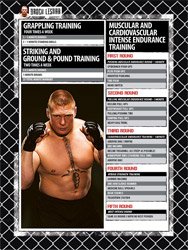
Brock Lesnar Strength Workout

Sample Strength Training: 1 Hour Workout Duration

Leading up to a fight, these exercises need to be conducted with less weight, higher intensity that will also work on overall conditioning.

Day 1: Chest & Triceps

  • Bench Press: 6 Sets 12 Reps
  • Incline Dumbbell Press: 4 Sets 10 Reps
  • Dumbbell Flyes: 3 Sets 8 Reps
  • Cable Crossovers: 3 Sets 8 Reps
  • Triceps Dips: 4 Sets 10 Reps
  • Triceps Pushdowns: 4 Sets 10 Reps
  • Skull Crushers: 3 Sets 10 Reps

Day 2: Back & Biceps

  • Wide-Grip Pull-Up: 4 Sets 6 Reps
  • Medium-Grip Pull-Up: 4 Sets 6 Reps
  • Narrow-Grip Pull-Up: 4 Sets 6 Reps
  • Seated Cable Row: 4 Sets 6 Reps
  • Stiff-Legged Deadlift: 4 Sets 6 Reps
  • Deadlift: 4 Sets 6 Reps
  • Preacher Curl: 4 Sets 12 Reps
  • Hammer Curl: 3 Sets 10 Reps
  • Incline Dumbbell Curl 3 Sets 10 Reps

Day 3: Shoulders

  • Overhead Barbell Press: 4 Sets 10 Reps
  • Seated Dumbbell Press: 3 Sets 10 Reps
  • Dumbbell Front Raise: 3 Sets 10 Reps
  • Dumbbell Lateral Raise: 3 Sets 10 Reps
  • Smith Machine Upright Row: 4 Sets 6 Reps
  • Barbell/Dumbbell Shrug: 4 Sets 6 Reps

Day 4: Legs

  • Leg Extension: 3 Sets 10 Reps
  • Leg Curl: 3 Sets 10 Reps
  • Narrow-Stance Smith Machine Squat: 4 Sets 6 Reps
  • Medium-Stance Smith Machine Squat: 4 Sets 6 Reps
  • Wide-Stance Smith Machine Squat: 4 Sets 6 Reps
  • Leg Press: 4 Sets 6 Reps
  • Stiff-Legged Deadlift: 4 Sets 6 Reps

Brock Lesnar MMA Muscular & Cardio Intense Endurance TrainingBrock Lesnar MMA Muscular & Cardio Intense Endurance Training

1st Round: Pushing Muscular Endurance - 1 Minute

  • Spiderman Push-ups
  • PlyPush-ups
  • Mounted Punching
  • Tire Push
  • Hand Switch

2nd Round: Pulling Muscular Endurance - 1 Minute

  • Recline Pull-ups
  • Bodyweight Pull-ups
  • Pulling/Pushing tire
  • Jumping Pull-ups
  • Heavy bag Twirl

3rd Round: Cardio Endurance Training - 1 Minute

  • Airdyne Bike (70rpm)
  • UBE Machine
  • Incline Treadmill (as steep as possible)
  • Windsprint Bike (standing full time)
  • Airdyne Bike

4th Round: Hybrid Strength Training

  • Jammer Machine
  • One arm Sledge Hammer
  • Medicine Ball Sprawls
  • Bear Crawls
  • Transition Station

5th Round: Most Intense Round - No Rest Periods

  • Airdyne Bike (70rpm)
  • UBE Machine
  • Incline Treadmill (as steep as possible)
  • Windsprint Bike (standing full time)
  • Airdyne Bike

Wednesday, December 23, 2009

Strength Training Over Age 50

Are there special guidelines for aging athletes?

By Elizabeth Quinn, About.com Guide

Updated: July 08, 2008

The American College of Sports Medicine (ACSM) now has fitness guidelines specific to weight training for people over 50. The advice: perform such exercises 2 to 3 times a week to condition all of the major muscle groups -- arms, legs, shoulders, and trunk. The goal is to lift a weight that's heavy enough to achieve 10 to 15 repetitions per session before the muscles become fatigued.

Most older individuals are well aware that they need regular aerobic exercise, such as walking, swimming, or running, to strengthen their heart and lungs and tone their bodies, but many dismiss weight training (also called resistance training) as an activity predominantly for the young or the vain. However, it is the only type of exercise that can substantially slow, and even reverse, the declines in muscle mass, bone density, and strength that were once considered inevitable consequences of aging. Unlike aerobic, or endurance, activities, which improve cardiovascular fitness and require moving large muscle groups hundreds of times against gravity, weights provide so much resistance that muscles gain strength from only a few movements. Resistance is usually provided by free weights or machines, but individuals can also get stronger by exercising in water.

People shouldn't experience pain while lifting weights, but it's normal to feel some soreness the next day. Experts believe that as muscles are challenged by the resistance of a weight, some of their tissue breaks down; as the muscles heal, they gradually increase in strength and size. Although muscles should be worked until they are fatigued, common sense will dictate when it's time to stop. If you feel joint or nerve pain, or are putting a tremendous amount of strain on any part of the body, you're probably going overboard and can harm yourself. Because strains, sprains, and tissue damage can take weeks or even months to heal, preventing injury should be a priority. Although many older people who are inactive but want to get moving may think that a pair of walking shoes is a wiser investment than a set of weights, the opposite may actually be true, say fitness experts. People who have been sedentary for long periods are at high risk for falls because their muscle tone is weak, flexibility is often limited, and balance may be precarious. To reduce the risk of falls and injury, people over 60 who haven't recently been active should begin by strengthening their legs, arms, and trunk muscles with 3-4 weeks of weight training 2-3 times a week before walking long distances or engaging in other aerobic exercise.

Because aerobic activity and strength training are each important for health, the ACSM recommends that able adults do both on a regular basis; 20 to 60 minutes of aerobic activity is advised 3 to 5 days a week and weight training should be done for 20 to 30 minutes 2 to 3 times a week. The guidelines also suggest that people perform stretching exercises -- which increase the range of motion, or amount of movement, of joints -- a minimum of 2 to 3 times a week.

In general, as people grow older, their muscle fibers shrink in number and in size (atrophy) and become less sensitive to messages from the central nervous system. This contributes to a decrease in strength, balance, and coordination. Although there is no question that people experience at least some of these declines at about age 40, the extent to which they occur depends on a number of factors, including genetics, diet, smoking and alcohol use, and -- most important -- physical activity level. Indeed, recent research has indicated that inactivity is responsible for the majority of age associated muscle loss. Fortunately, resistance exercise can reverse much of this decline by increasing the size of shrunken muscle fibers.

It is also well known that weight training can increase bone mass, which lowers the risk of developing osteoporosis and fractures. Strength training adds more weight to the skeleton by building muscle; this stimulates the bones to strengthen and grow to bear the heavier load on the muscles. Once achieved, much of the gain can be maintained through weight-bearing endurance activities such as brisk walking, stair climbing, and aerobics. Resistance exercise can also help older people live independently by giving them the strength they need to perform everyday tasks. There is even evidence that resistance exercise can help people sleep better and can improve the mood of mildly to moderately depressed individuals. And because proper strength training doesn't apply stress directly to joints, it is ideal for people with arthritis; indeed, rheumatologists often recommend it. Although it cannot reverse arthritic changes, lifting weights helps alleviate symptoms by strengthening the muscles, tendons, and ligaments that surround joints.

Monday, November 30, 2009

Will Lifting Weights Help My Running?

Here's an interesting article on running and weight lifting. Is it beneficial or not? What do you think?

This is a very popular question. Read running magazines and you will think the answer is obvious. Well, do a little more research and the answer becomes much more fuzzy.

The first research I suggest doing for any questions of training is to look at what the elite runners do. These are the people who have gotten the most out of their training. They have figured out what is worth their time and energy and what isn't. So, what do the elite runners do? Well, very few elite runners who focus on events of 5k and up go anywhere near weight rooms. That doesn't mean they don't do strength training, though. The most popular form of strength training for elites is running hills. Repeats, circuits, easy and long runs over hills, fartleks, you name it. The bottom line is that they spend a lot of time running up and down. That's not all they do, though. Core strengthening is something that almost all of them do. Abdominal training is done by many elites. Circuit training is also popular with some, as well as body weight exercises, like pushups, pullups, step-ups, one-leg squats or lunges, one-leg hops or toe raises. Some, although they are a distinct minority, especially as their goal distance becomes longer, also lift weights.

Another form of research that I like to look through would be scientific studies. So, what do they say? Well, not a whole lot for lifting weights for distance runners. Studies have shown that lifting weights is most likely beneficial for racing distances that take less than 10 minutes to complete. What about the longer distances? Well, things change sharply. In fact, I have seen only one study that showed lifting weights is beneficial for "well trained" athletes and I found that study to be questionable. That study also said it is beneficial for the 5k but findings were inconclusive once the race distance was over 20 minutes. I have yet to see one study that found weight training to be beneficial for anything longer than that. What about athletes who are not "well trained"? Well, studies have shown that adding weight lifting on top of their current training routine does help improve performance, which makes sense. You are increasing training load. Regardless of what that training is, increasing training load will increase fitness. But there's a catch. Using that increased training load to do more running instead of lifting weights leads to much more significant performance improvements. In the end, almost all studies have found that lifting weights has no statistically significant positive effect on racing performance in events of longer than 10 minutes and some suggest that there may be a negative effect on performance. What about other forms of strength training? Well, studies have shown that running hills is one of the most beneficial forms of training that a runner can do. Circuit training, core training, and body weight exercises haven't been studied enough to offer any quality assessments.

Of course, there is one variable that I have purposely left out so far. Many people believe lifting weights is good for injury prevention. While this sounds great, for the typical biomechanically sound runner, there is simply no evidence supporting these claims. In fact, in an unscientific study of one, my injury rates have been higher when lifting weights (under the supervision of trainers and strength and conditioning coaches) than when not lifting weights. On the other hand, if you have a biomechanical inefficiency, lifting weights may make sense to correct any imbalances.

In the end, there is not a whole lot of evidence supporting the use of weight training for performance benefit. This doesn't mean it's not worth a shot. Experiment, we are all studies of one. However, as I always say, why assume you are in the minority when chances are you are in the majority? If weight training isn't working for you, move on and find something that would make better use of your limited training time and energy. If you have to decide between a few extra miles on the roads or hitting the weight room, by all means, run a few extra miles. That is where you are going to get the best performance benefit.


Friday, October 30, 2009

The One Leg Squat and Reach Exercise Isolates the Gluteus and Improves Balance


Isolate Your Gluteus and Build Better Balance and Core Strength

By Elizabeth Quinn, About.com

Updated: May 13, 2009

The one-leg squat-and-reach exercise builds balance, ankle strength, proprioception, gluteus muscle strengthening, and trunk stabilization.

Using this type of stability exercise challenges your balance and engages muscles that are used while performing any exercise your perform with one leg at a time, such as running, cross country skiing, and even cycling.

This exercise is also a good way to regain balance and stability after an ankle, hip or core muscle injury. By maintaining this stable position during the exercise, you will engage your glutes, hips and core muscles by working many muscles at one time.

Basic One Leg Squat and Reach:

  • Place an object on the floor about 2-3 feet in front and to the left of your left foot.
  • Balance on your left foot; raise your right foot off the ground.
  • Slowly bend your left knee and lower your torso.
  • Reach forward with your right hand and touch the object.
  • Maintain your balance by extending your right leg slightly.
  • Be sure to keep your left knee over your left foot.
  • Touch the object, pause, and return to the start position.
  • Maintain a slow and controlled movement throughout the exercise.
  • Repeat the exercise 5-10 times. Switch feet and repeat on the other side.
  • Complete 2 sets.

Advanced One-Leg Squat-and-Reach:

  • Because shoes offer additional support, you can increase the difficulty of this exercise by performing it barefoot. This engages the small muscles of the foot and ankle that stabilize the ankle and maintain balance.
  • You can also hold a small, 5-8 pound dumbbell in your hand as your reach forward and slowly reach out to the left as far as you can go, pause 3 seconds and then slowly return, switch hands and reach to the right.
  • Repeat 10-15 times on each side and switch to the opposite foot and hand.
  • Do 2 sets for each side.

Wednesday, October 07, 2009

Vast Applications

Individualization has vast implications for your entire fitness program— not just exercise. For instance, just because 99% of Americans rely on commercial gyms for their fitness needs doesn't mean that YOU have to. You may prefer to train at home, or even outdoors. Today, people have access to an almost limitless variety of exercise modalities, including aqua fitness, martial arts, elastic resistance bands, yoga, dance, you name it. Many roads lead to Rome, so do what you enjoy.

Smart athletes also know that nutrition must be individualized as well. Case in point: English bodybuilder and elite strength athlete Gary Taylor. Despite the conventional advice of eating a high protein diet, Gary feels he does best on high carbs and low protein. With a 600 pound behind-the-neck push press to his credit, it's hard to argue with his unique approach.

Your goals don't need to be structured in conventional ways, either. While most seek more muscle or strength, you might find more satisfaction pursuing other objectives, such as everyday functional ability, or simply the sense of well-being that comes with following an exercise program. It's important to enjoy the process of training. If you're getting the results you want, don't change a thing. But if you're still not satisfied, try the suggestions we've outlined here. Lastly, remember that your individuality is a dynamic concept. As you progress, your exercise program must be constantly modified.

That's right. Your body will help determine what you need. If you get stuck, get some help.

Not only do our fitness goals determine what type of exercise we should do, but also our personalities. Some people find gyms boring, but they love salsa or bhangra class. I chose martial arts because I'm rambunctious, and I supplement it with weight training & cardio. One one person likes, another doesn't.

You probably won't see me running any marathons. Not because I can't, but because it doesn't interest me. However, some people get complete ecstasy from it. The point is, choose the activity you like most and work around that to determine the best way for you to be fit.

-Melissa


Wednesday, September 02, 2009

Cardio at Home

Home Cardio Exercise: Mountain Climbers

One of my personal favorites. I get mighty tired after about 20 of these.

Mountain Climbers. This is a great conditioning exercise that increases core strength and endurance. To perform this exercise correctly:

1. Begin in a push-up position (arms lined up with the chest, legs extended out)
2. Make sure to keep the head in line with the body and the stomach muscles contracted throughout the range of motion.
3. Start the movement by bringing the right knee to the chest and back to starting position.
4. Quickly alternate to the left leg and continue this movement for a timed period (anywhere from 30 seconds - 5 minutes).

This home cardio exercise tip brought to you by the Dallas personal trainers from Fitness Trainers To Go.

Monday, July 13, 2009

Motivational Tip #3

Once again, I'm sharing from Kathy Smith's website. Since she already said what I'd say, why recreate it? Once again, note my bolded notes and italicized comments below.
Melissa

Find a Passion

Why is it that when we fall in love or are excited about an opportunity, we seem to enjoy boundless energy and can go for days with very little sleep?

The reason is passion. (Going to the gym isn't for everyone; nor is running, swimming or martial arts. However, find what you love and balance it with strength training, cardio and healthy eating.)

A few years ago when I was watching a PBS series hosted by Bill Moyers, it caught my attention when the great mythologist Joseph Campbell urged us to follow our "bliss." (or as Susan Ruth says, "do what feels good.") That's what I've done in my life. I follow my bliss, which I interpret to mean passion, and I encourage you to find and follow your own.

I once read a fascinating report on longevity that discussed a study of 100 people who were then in their nineties or older. The study's author said that he could find only two traits common to all 100 people. The first, that they'd eaten a consistent diet their entire lives, meaning that they'd had no extreme weight losses or gains. But it was the second trait that most captured my attention: All the old people were extremely interested in something outside themselves, whether it was religion, a hobby, or volunteering, etc. In other words, they'd found a passion.

In the early 1980s I began putting together everything I'd ever learned about exercise, fitness and health into teaching an aerobics class in Los Angeles. Though my pay was only about ten dollars per class, I considered myself incredibly rich and successful. Why? Because every day some woman, age thirty to fifty, would come up to me and admit, with tears in her eyes, that since reaching adulthood she hadn't moved her body the way she was doing in my class; she thought she'd forgotten how. But now, after sticking with it for several months, she'd begun to feel her entire life change. "I've decided I'm going to go out and get a job," was a common statement of joy. Others bragged that sex with their husbands had picked up again after a long layoff.

I could see that I was impacting these women, that their self-confidence had been raised and their well being improved. The first step had been moving their bodies, the next - well, who knows. (It's true that exercise boosts your self-confidence. If you've ever seen Vicki Virk teach bhangra (http://dholrhythms.blogspot.com/2008/06/classes.html), her passion and confidence emanate to all within her vicinity. It's contagious. Imagine your passion and how it would affect your daily life).

Later, I became the co-host of a USA Cable show called Alive & Well, on which I led a daily mini-class of exercise. Suddenly, I began receiving thousands of letters that echoed the sentiments of these women who'd come up to me in class. Heartfelt letters, describing the enormously positive changes they were experiencing. Eventually, with message boards and emails, the XX kept coming in.

To tell you the truth, the reason I continue to do what I do in my professional life is that I'm committed to helping, and inspiring the best in all people. Nothing gives me more pleasure than to hear that, for whatever reason, I've inspired someone to consider today the first day of the rest of her life.

I remember an appearance at a store in Minneapolis's Mall of America. A man and his nineteen-year-old daughter waited in line for an hour to tell me their story. It seems that, two years before, the daughter had decided to drop out of high school because of depression, feeling that her life was worthless. Distraught over his daughter's decision, about which he could do nothing legally since she was past sixteen, the father tried every form of persuasion, even bribery. Nothing worked. Then one day he happened to see a poster of mine that read, BELIEVE IN YOURSELF. He bought it, along with one of my exercise videos, and brought them home to her. Resistant at first, she tried the video, and then hung the poster. Within weeks, she'd exercised out the depression and taken the slogan to heart. She stayed in school, graduated, and was, when I met her, enjoying her freshman year of college. Both father and daughter had tears in their eyes, and so did I.

Handing me both the poster and the video, the daughter said, "You made me believe I could do it, that I could do something with my life."

As we hugged and exchanged tissues, I understood the emotional connection between us: We both shared a passion for exercise, and she, like me, now understood that it had expanded her options by allowing her to notice more opportunities, and to take better advantage of them, which is exactly what it has done for me.

If she'd asked me to explain to her the cause and effect of exercise and its results, I would have said that, as scientific research has demonstrated, exercise has a healthy effect on the human mind and spirit, as well as the body.

Now, does exercise automatically lead to major life changes for everyone? No, probably not. (Certainly it does for most, but perhaps your passion is in model trains, blogging or cooking. Be passionate about something. Too many people let work rule their lives. Have a life outside of work and family. It's so important for you).

Personally, I've found that my thinking is often at its most creative when I'm working out - whether running, walking, lifting weights, spinning or hiking in the hills. It's a conscious choice, to use the time productively. I'm fully aware that a lot of people abandon their exercise programs because they get bored. They lose their passion.

"Don't you?" they ask.

Lose my passion? Never. First of all, I don't let myself get to that point, I cross-train, moving from one activity to another nearly every day. Second, I don't get bored because there's so much to think about when I'm exercising. Sure, the activity itself can be repetitive, but that very repetition frees the mind to go elsewhere.

Exercise initiates physiological reactions that also lead to subtle changes in thought processes. In the calm of an exercise-induced alpha state, I trust my mind to be more agile, so I tend to follow where it wants to lead me. During exercise, my mental state reflects the best of me from the deepest recesses of my soul.

Even when I don't need to solve a particular problem, I often use the time to take stock of my life. Am I being a good listener? Am I using my time wisely? Am I pursuing the things I want?

Other times, I spend my workout enjoying some detailed daydreaming such as getting lost in nature - enjoying the sights, smells, and sounds. And finally, I also brainstorm solutions to problems at home or work during my workout. Often this brainstorming will lead to some creative solutions.

Now all these years later, I still revel in my passion for exercise. Being connected passionately to one thing leads to other areas of passion, including one for life in general. You then naturally want to experience more, be more involved in life. You develop a healthier lifestyle, and that means not having to focus so single-mindedly on food, your weight, your body image, your finances, or whatever.

I encourage you to nurture a passion for fitness, and let that passion connect you to other dreams and other passions. From art to cooking to gardening to travel, let exercise be your guide.

Whatever your dreams, follow their trail. Go where they lead. Listen to your heart. Chase your passions.